Monday, February 19, 2024

Trauma and the Voice

I recently read (and am now re-reading) a book called Trauma and the Voice: A Guide for Singers, Teachers, and Other Practitioners by Emily Jaworksi Koriath. One statistic it highlights is that people are more likely to have experienced abuse or neglect than they are to be left-handed. Therefore, most of us are carrying around some degree of trauma. 

Koriath outlines the recent understanding that places traumatic experiences into two broad categories. The first is shock trauma, where we experience events that overwhelm our system's capacity to respond to threat in real time, such as the speed and danger of a car accident, violent attack, or a sudden fall. The second category is developmental trauma, which refers to the long-term effects and psychological issues that result from abuse and/or inadequate care during critical periods of development. 

She also highlights how some writers have begun to differentiate between what they call "Big T Trauma" (life-altering events) and "little t trauma" (instances of cruelty, silencing, bullying, or shaming that leave their imprints on us). Neuroscientist and researcher Dr. Stephen Porges refers to trauma as "a chronic disruption of connectedness." Author and activist Staci Haines calls trauma "an experience, series of experiences, and/or impacts from social conditions that break or betray our inherent need for safety, belonging, and dignity." 

As you can see, there are many forms and degrees of trauma. Koriath presents her own working definition of trauma, paraphrased from Resmaa Menakem, as something that occurs in the body when the nervous system encounters more than it can process in real time. That “more,” she says, could be light, noise, violence, shame, or any number of other things. The in-the-moment response to this overwhelm is generally to shut down or “numb out.” As a self-protective measure, the mind fights to forget trauma. But, Koriath points out, the body remembers. 

Koriath also cites psychologist Peter Levine who indicates that trauma is not in an event itself, but in the nervous system’s response to the event. Each of us has a different threshold for what events are tolerable and which may result in trauma in the system. As Koriath emphasizes, “Even identical twins can live through the exact same circumstance, and one will experience the event as traumatic and the other may not.” 

It is not, therefore, up to outside observers to decide if someone has been “legitimately traumatized,” since we all process events differently. As Koriath states, “If there is stuck energy in the nervous system, it’s real trauma to that person.” Significantly for singers, if this emotional energy is stored in the body, it can inhibit our best singing and storytelling, which comes from free and unrestrained bodies. 

As a voice teacher, it is way beyond my expertise and scope of practice to try to identify trauma, point it out to my students, or attempt to help them work through it. Instead, as Koriath states, “Our responsibility is to be aware of the prevalence of trauma, and to adopt practices that contribute to nervous system care.” 

Luckily, she gives some specifics. For instance, when singers are in performance studies (like a degree program in musical theatre), they are constantly moving in and out of states of “fight, flight, and freeze.” Because bodies react differently to the feelings of overwhelm that come from perceived threats, our individual systems find ways to keep us safe that Koriath calls “innately brilliant and unique.” What we experience in those moments of stage fright or performance anxiety is the natural response of a healthy and adaptive nervous system. You are not wrong, bad, or "not cut out for this business" if you experience any of these normal, healthy anxieties. Koriath believes we should be better about normalizing the body’s response to the heightened state of performance. Once singers learn to recognize this process as not only healthy but necessary, they can choose to cooperate with it for more freedom onstage. 

How has your practice been this week? How can you stay focused in these last weeks before spring break? 

Now go practice.


Sunday, February 4, 2024

Sondheim did the work for you.

I wrote a blog back in 2016 about when it's OK to deviate from the score or change the notes of a piece of music. I think it was inspired by hearing someone in the MTP say, only somewhat jokingly, "Opt up or opt out!" 

Unsurprisingly, I don't agree with that philosophy. That being said, although I am generally a "stick to the score" kind of guy, I do think there are times when it's appropriate to sing something that isn't on the page, which I outline in that previous blog. (Read it here if you're curious!) 

My teacher at Indiana University, Dr. Robert Harrison, often reminded his students that the text, pitches, and rhythms in a piece of music represent the innermost thoughts of a composer and poet (or lyricist). Our first duty as performers, he would say, is to accurately reflect those thoughts. If we feel license to change those notes, it's almost like we're saying we know this piece of music, and the thoughts that inspired it, better than the person who thought those thoughts and turned them into a song (Oh the thinks you can think!). To this line of thinking, Dr. Harrison would sometimes say, "Go write your own damn song! Stop recomposing this one!"

One instance when Dr. Harrison and I both agree it may be warranted to change the notes and rhythms of a song is if it is with the primary intention of enhancing the communication of the text. A great example is text that is set to four quarter notes with one syllable per note. If we were to speak a phrase in such a strict rhythm, it would probably sound monotonous. As singers, it's likely that we would make the emphasized syllables in that text a bit louder and the de-emphasized syllables a bit softer. We may also dot the rhythms, giving the emphasized syllables a bit more rhythmic duration and the de-emphasized ones a shorter duration. In this way, we're helping the audience understand the text by putting them into more of a speech-like rhythm. 

This is the opposite of the "Opt up or opt out" philosophy (singing a higher note than what is written), whose primary intention seems to be to show off something that the voice can do rather than enhancing the communication of the text. 

In my mind, there are certain composers whose music needs very few adjustments, primary among them Stephen Sondheim and Jason Robert Brown. Unsurprisingly, both of them served as composer AND lyricist in most of the music they have written.  When that's the case, I pay particularly close attention to the way they merge text and musical phrases, assuming that every detail was chosen intentionally. 

I still believe this even though there are some incredibly famous singers who have incredibly well-known recordings of the songs of these incredibly well-recognized composers where they (incredibly) take a lot of liberties with the incredibly well-written notes and rhythms. (Case in point: You folks doing Into the Woods right now, have you compared your part the way you learned it to the original Broadway cast recording?)

How did they get away with such shenanigans? Well, I wasn't there, so I don't know. But, in some ways, trying to reinvent this music makes your job harder as the performer. As David Eggers said in Dem Lab recently, "Sondheim did the work for you." If we just focus on presenting his music the way he has written it, more often than not, the message will probably come across. 

How has your singing been? How have you been negotiating your practicing and vocal progress amidst your show schedule? (I think my entire studio is rehearsing a show right now—or just finished one, or is about to start one.)

Now go practice. 


Sunday, January 21, 2024

O Holy Vibrato

One of the best things about the break between semesters is that it affords us the time to do things we enjoy that we don't always have time for during the school year, like watching movies, hanging out with friends and family, or analyzing the vibrato rate and extent of pop singers. 

OK, maybe I was the only one who did that last one. Let me give you some background. 

At one point during the holidays, I was listening to an all-Christmas music radio station and they played songs performed by Aaron Neville ("O Holy Night") and Josh Groban ("Believe") back to back. If you don't know who Aaron Neville is, this duet he sang with Linda Ronstadt in 1990 was one of the big pop love songs when I was growing up. Although, to hear his unique vibrato, you only need to listen to the first few seconds of his rendition of Schubert's "Ave Maria." 

Most of you are probably familiar with Josh Groban, given his stardom in both pop and Broadway spheres. His ever-present, quick vibrato is part of what I believe makes it difficult to categorize where he best fits, genre-wise. 

Regardless, hearing these two singers back to back, I was really struck by how different their vibrato rates are. So, I pulled out the spectrogram (VoceVista Video Pro) to see if I could measure the differences. Those of you who were in "Vocology Day" at Dem Lab (or who just had Voice Pedagogy with me) may remember a bit about VoceVista. As a research tool, it's tremendously useful for voice analysis. But, for my purposes, I kept it pretty simple and just gave it the eyeball test. 

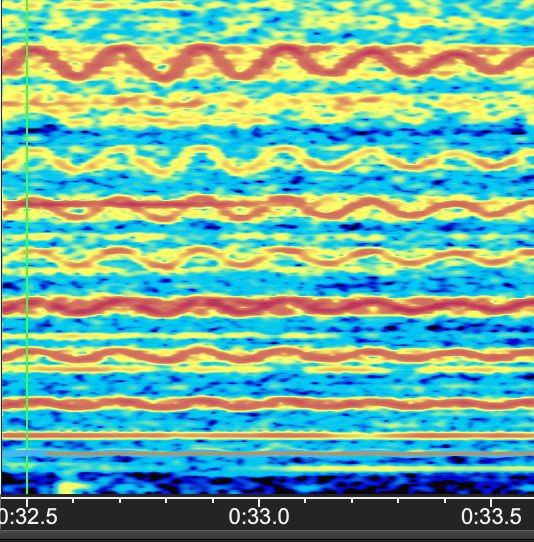
I looked up recordings of both Neville and Groban singing their own versions of "O Holy Night." This first picture is from Neville singing the climactic note on the word "night." 


In the middle of the screen, the wiggly lines show his vibrato. The number of wiggles per second indicates his vibrato rate. How far above and below the pitch each wiggle travels indicates his vibrato extent. In the picture above, we can see that his rate is about 4.5 cycles per second and his extent is not that extensive. 

Earlier in the song, Neville sustained a less climactic note, which looks like this: 


Here, the rate is almost exactly the same as in the other example (about 4.5 cycles per second). But, looking again at the middle of the screen, you can see that the extent (the size of each bump) is much greater. This means that he is singing much further above and below the pitch. 

In Groban's rendition, his climactic note is on the second syllable of the word "Noel," which looks like this: 


His vibrato rate is roughly 5.5 cycles per second, which is an entire cycle faster per second than Neville's. We can also see that his extent seems to be somewhere between Neville's two examples—wider than Neville's climactic note but not as wide as his second example. Groban's extent also seems to be more consistent in this one-second selection than Neville's, especially in the second example where the peaks and valleys had more variability. 

So, what does all of this mean? For starters, it would seem to confirm what my ears had already told me, that these two singers use their vibrato quite differently from each other. But it also zeros in on how they are different. My suspicion was that Neville uses an unusually slow and wide vibrato. Though it is somewhat slow, it is sometimes wide in extent and sometimes quite narrow. My suspicion for Groban was that his vibrato is faster and wider than most other pop singers. We see in these selections that it is faster than Neville's, but in extent it's somewhere between Neville's two examples. 

I think there is a natural follow-up question to all of this analysis: Which vibrato is better? Well, it depends on what we mean by "better," I suppose. Both singers have made major careers singing the way they do. Neville, who is now 82 years old, has four platinum albums and four top-10 hits as an R&B and soul singer. Groban, who is now 42 years old, has four multi-platinum albums in styles that have been classified as everything from easy listening to pop rock to operatic rock (better known as "popera"). He's also played two leading roles on Broadway. Have these two singers been so successful because of their unique uses of vibrato or despite them? It's probably impossible to say. 

One thing we know about musical theatre singing is that a variety of vibrato rates and extents are used, depending on what era or style of musical theatre is being performed. That can range from a wide and fast vibrato to no vibrato at all to a note that starts with no vibrato and then ends with lots of it! What is "better" may depend on the style, the situation, the emotion of what is being expressed, and what works best in the voices of individual singers. 

How has your singing been this week? 

Now go practice.


Sunday, January 7, 2024

Tiny victories

Happy New Year! 

New semesters and new calendar years are great opportunities to evaluate our big-picture trajectories and then zero in on the day-to-day routines that will help us get where we want to be. I came across some wisdom on this topic on The Mental Game of Musical Theatre podcast by our friend David Eggers. There is a lot of outstanding advice in this podcast coming from David's interviews with Broadway professionals. I recently listened to the episode with actor, singer, and songwriter Gavin Creel and was struck by the way he describes the importance of seeking small, daily joys—what he call "tiny victories." (The two-part episode with Creel is available here and here.).

Essentially, Creel believes that storing up regular tiny victories gives us balance and perspective that allows us to better handle the aspects of life that do not work in our favor. For him, a tiny victory sometimes comes from trimming his hydrangea bushes, or engaging in conversations with the server ("Emma") at his local deli, or committing to regular meditation sessions. By amassing these sorts of small joys, he feels more grounded when challenges arise related to his work ("like walking into that audition room, or weathering that call, 'I'm sorry, Gavin, it's not going your way'") or when faced with one of life's inescapable, larger disappointments ("those breakups, those losses, those deaths"). As he says,

"Those big, big, big things that seem insurmountable are coming for you, for me, for all of us. If I don't have a practice in place for me to be able to weather those things, you'll get through it, but it makes it makes it a lot harder."

While this is powerful advice for big-picture life events, I think the same philosophy can be applied to small-scale events like vocal practice. When we are practicing difficult material, or working to develop complicated techniques, each practice session has the potential to accumulate "tiny losses" or even (to be a bit dramatic) "tiny tragedies." Does the world stop spinning if you crack on a high note? Of course not, but it doesn't feel good when it happens. As we have discussed previously, incorporating "desirable difficulties" that take focus and effort to overcome is an important part of meaningful practice. As singer and voice teacher Aubrey Adams-McMillan posted recently, "Making mistakes is a sign of effort," and both mistakes and effort are necessary for progress. [Consider revisiting "Failure is the only option"]

So, maybe what our practice sessions need in 2024 are intentional tiny victories in order to offset the inevitable tiny tragedies that are part of effortful practice. Maybe every practice session needs to include time when you sing something you love just because you love it. Maybe in every session you should stop at some point to recognize, "Hey, that's something I couldn't do two years ago!" Maybe when you notice the bad feelings that come along with tiny tragedies, you can say, "I'm feeling frustrated by this because I'm a sensitive person, and being a sensitive person is a big part of what makes me a great artist." 

I would guess that, in some sessions, there may seem to be more tragedies than victories (tiny or otherwise). But, if we follow Creel's advice and look for more tiny victories to recognize, the balance may swing in a more positive direction. 

What are some goals you have for this semester in the voice studio? What are some tangible tiny victories you can bring into your singing? 

Now go practice.


Sunday, November 26, 2023

Great light

I was having a conversation with a student recently about plateaus. This student was remembering a previous blog in which I had discussed the plateaus we experience in our vocal training where it feels like we can go for an extended time without making any progress. These are inevitable periods that everyone goes through—no one's trajectory is only forward. It's also worth noting that a plateau can actually be a form of progress, because we are solidifying our status on higher ground (at a higher skill level) than we used to be. 

This idea reminds me of an experience I had last summer when I was out on a hike. While trekking toward a peak in the Wasatch range, I looked across the valley and saw how the clouds were casting a shadow on a significant section of the opposite ridge (picture below). From my vantage point, I could see that most of the mountain was in sunlight. But I remember thinking that any hikers who happened to be in the middle of the shadowed section probably wouldn't be able to tell how much longer they would be in that darkness before they would be back in the sun. 

This time of year, it is a tradition for musical ensembles to program performances of Handel's Messiah, the great oratorio for symphony, chorus, and vocal soloists. One of the arias for bass soloist is assigned the text, "The people that walked in darkness." At the start of the piece, the vocal line meanders, winding around in chromatic eighth notes before landing on a low F2. It's as though the melody itself is searching for a way out of darkness only to be plunged into the depths. 


As the aria continues, however, the chromaticism starts to dissipate and the melody ascends to a sustained high D4 (the tonic of the key) on the phrase "have seen a great light." 


It feels a lot like a hiker working through the muddled darkness of a shadowy ridge only to emerge onto a sunlit peak. In the picture below, you can see that the entire last stretch of the hike toward the peak on the left is in the shadows. As most mountain hikers know, the last stretch before a peak is often the most difficult. It is usually the steepest part of the hike and can involve scrambling up loose rocks that have less-secure footing than the lower sections of the trail. Add darkness to the mix and all of these factors could make any hiker want to turn around and head back down the mountain, right when they are closer than ever to the peak. 

The end of the semester is also a peak, of sorts. Even if it doesn't necessarily feel like you are reaching a monumental finish, it does represent the end of a long, sometimes meandering hike. When we are amid the difficulties and darkness of a semester (or a degree program, or a career), it's tough to know how long we will have to endure before we reach the light. And when we are on drawn-out journeys, the longer we trudge, the more arduous it can become. But that could also mean that the peak, and the light, are just a few more steps away. 

Keep hiking. 

I'm grateful for the semester we have spent together. Once we finish, I hope you will all look back at how far we've come and take a bit of time to enjoy the view. 

Happy Holidays. 
-brian


Sunday, November 12, 2023

Get out of the way

"Condition the voice, and then get out of its way." -Kate DeVore
I was recently going through some notes and came across the above quote by Chicago-based acting voice coach Kate DeVore. She is a regular faculty member at the U's Summer Vocology Institute, so I think it was something I wrote down during her lecture this past summer. 

I think the most obvious interpretation of this quote is that we should build our technique in the practice room so we don't have to think about our technique during performances. Once on stage, we should get out of the way and just focus on storytelling. 

A second interpretation is that, after we condition the voice, we should get out of our heads. Anxiety, insecurity, and self-consciousness are all obstacles to free vocal expression. Sometimes, we might need to get out of our own way and trust that our voices will follow. 

As a voice teacher, however, this quote hits a little differently. When working with singers, it's sometimes hard for me to know when I should step in and when I should just stay out of the way. "Condition the voice," as Kate says. That's my job, to help you all condition your voices so they are better equipped to do what you want them to do. But there is an unfortunate tendency in voice teaching to homogenize the singers we work with. If teachers have an '"ideal" sound in mind that they feel every student should aspire to, that might mean that everyone will start to display the same timbre, sing with the same style, and make similar interpretive choices. In other words, we can "condition the voice" so much that we condition singers' originality and uniqueness right out of them. 

I know I'm guilty of inserting my preferences and opinions at times in the voice studio when I should probably be staying out of the way and allowing students to have more agency in deciding what choices they would like to make with their voices. In previous generations of voice teaching, students were often only allowed to exercise creativity from within the bounds of pre-approved options that the teachers laid out. Students who insisted too vehemently on adhering to their own ideas were seen as defiant or as questioning the authority or expertise of the teacher. Thankfully, we're trending away from that. Even so, I still find myself defaulting back to that approach once in a while. 

As we get closer to the end-of-semester performances, I hope you will all honor your own ideas. Obviously, you should consider the perspectives of your teachers and practice lots of different sounds and interpretive options. But once you get to performance, you are the ones center stage. 

In these last few weeks, how can you work to honor your unique voices and choices in the songs you are presenting? 

Now go practice. 


Sunday, October 29, 2023

What you want vs. What you need

If you were a high school theatre student in Utah, it's likely that you attended the Utah Theatre Association conference. This is an annual event designed to give high school theatre students and teachers the opportunity to see performances, attend lectures and workshops, and just geek out together about theatre. It's a huge gathering that attracts thousands of students from all across the state. Considering that they're all teenagers, and they're all theatre kids, there is always a lot of energy at the conference. And a lot of noise. And several students wearing age-inappropriate hats, like a sophomore rocking a fedora because he decided that's his "thing" this year. (You do you, dude.)

I go to the conference almost every year to present workshops, usually on musical theatre singing. I always leave room for Q&A and often end up sticking around after my sessions to answer additional questions, which I always find encouraging since it shows me just how much the students want to know about this subject. 

One year, an enthusiastic young student said to me, "I really, really want to be great at belting. What's the best way to get an amazing belt sound?" I told her, "Well, there are a number of exercises you can use to really target your belt voice." She nodded her head eagerly. "But," I continued, "you should also train your head voice, which will help build your full vocal instrument, which will also strengthen your belt singing." She seemed less enthusiastic to hear that second part. 

There is often a disconnect in life between what we want and want we need. It's no wonder Aretha Franklin separated the two when she sang, "What you want, baby, I got it. What you need, do you know I got it?" Even the Queen of Soul knew there was a difference. 

Sometimes we may want something, but when we find out what is needed to obtain it, we may reconsider and decide it's not worth it, after all. Case in point, in The Picture of Dorian Gray by Oscar Wilde, the character Lord Henry Wotton says, “To get back my youth, I would do anything in the world, except take exercise, get up early, or be respectable.” In a previous blog turned article, I discussed the difference between "wishes and dreams" (i.e., things we'd like to accomplish but don't take any tangible steps to achieve) and "goals and plans" (i.e., things we are actively and systematically working to achieve). 

Famed operatic mezzo-soprano Jamie Barton, whom the New York Times dubbed "opera's nose-studded rock star," was not always motivated to achieve the high levels of performance that she has seen in her career. Her college voice professor, Dr. Brian Horne, said as much in an interview with Classical Singer

"[Jamie] herself would admit that I had to sit her down on a couple occasions to remind her that she would need to work harder if she wanted to have some chance of success,” he says. “More or less, I told her that I couldn't guarantee that she would succeed if she gave it everything she had, but I could guarantee that she wouldn't succeed if she didn't give everything she had."

At that point, she wanted to succeed, but she wasn't doing what she needed to find that success. Based on her 2023-2024 performance schedule (Houston, Valencia, Paris, Chicago, Munich), she has clearly righted the ship. 

What do you want from your singing? What do you think you need to do to get that? Lastly, and most importantly, are you willing to consistently and systematically do what you need to do to get what you want (not just when it's convenient or when it's easy)? 

Now go practice.