Sunday, January 24, 2021

Motivation

On January 4th, the University of Utah published the results of the Online Learning Survey conducted at the ends of each of the last two semesters. By administering this survey, University officials hoped to learn how well (or how poorly) we all adjusted to Zoom-based education. 

Based on the data, administrators identified the "Top three challenges encountered when taking online classes." Perhaps unsurprisingly, the number one challenge—experienced by more than half of survey respondents (57.65%)—was personal motivation. 

As we embark on another semester of online learning, this is something we have to address. We can't go on with business as usual when we have identified an issue that has led to struggles for more than half of the University community.

For this reason, I scoured my bookshelf, which contains more than 100 texts on voice, singing, and vocal pedagogy that I've been compiling since my first undergraduate vocal pedagogy class (in 1994!). I looked in the table of contents and index of every book to see if I could find anything on "motivation" or closely related terms. I was hoping to find information specific to motivation when it comes to musical and vocal practice that might be useful in springing us into action and out of the complacency that online learning can allow.  

Disappointingly, the majority of the books had no mention whatsoever of motivation, ambition, or even inspiration, unless it was in reference to breathing. It's a little surprising that all of these volumes devoted to pedagogy, which is defined as "the method and practice of teaching," would not have anything addressing how to motivate students to learn. What good is knowing how the singing voice functions if I can't inspire students to want to learn? 

Thankfully, I did eventually find a few books that discussed the topic, which I will explore over the next few blogs of the semester. 

The first mention I found was in Finding Your Voice: A Practical and Spiritual Approach to Singing and Living by Carolyn Sloan. She points out that when people fail, it's not always because of an absence of training or skill. Rather, it's often due to an absence of desire. She writes, "A lack of desire then becomes a lack of energy and a lack of energy causes our persistence to waver until it finally disappears altogether." (34)

If you are struggling with motivation, she suggests asking yourself this basic question: "Do I really want this?" As it relates to vocal work, I think the question may be, "Do I really want to become a more skilled and expressive singer?" If the answer is "yes," then the next question is, from a day-to-day or practice-by-practice basis, "Am I willing, TODAY, to do the work that will lead me to become a more skilled and expressive singer, even if I don't see those results immediately?" 

Sloan also believes desire is directly tied to imagination, stating, "Most activities in life require an overlapping of desire, imagination, skill, and training." (36) She suggests exercising and honing the imagination so we are better able to envision ourselves with the skill set we would like to possess. In other words, once you have decided if you really want to become a more skilled and expressive singer, you should use your imagination to identify what that may actually look and sound like. As Sloan says, "When you are sure of your intentions and the quality of your desire, the journey will be pleasant and the learning will be easier." (34)

Consider exploring these perspectives if you are feeling a lack of motivation or desire. Ask yourself if you really do want the skills you are tasked with building. Ask yourself if you are willing to work today, even in a small way or for a short amount of time, toward building those skills. Imagine what those skills would feel like and sound like in your body and your voice. 

And then go practice. 

Sunday, November 22, 2020

Sing like there's nobody listening?

There is a well-known quote that many of you have probably heard, in some version: 

“You've gotta dance like there's nobody watching,

Love like you'll never be hurt,

Sing like there's nobody listening,

And live like it's heaven on earth.” 

Internet searches most often attribute this to one of two authors—William Purkey or Mark Twain—but there seems to be some question as to its origin. (For instance, I'm not certain Mark Twain would use the word "gotta.")

Regardless of who said it, I have always found parts of the quote troublesome. Love like you'll never be hurt? OK. Live like it's heaven on earth? Sure. But sing like there's nobody listening? Hold on. 

I can certainly understand what I believe to be the main sentiment of the phrase. When we engage in activities that require vulnerability, like singing, it's easy to imagine that anyone listening may be negatively judging us (whether they actually are or not). This might cause us to become self-conscious and to sing in a way that withholds our true selves or protects our egos. Maybe we'll laugh at ourselves before others can beat us to it, or maybe we'll act like we weren't really trying that hard to sound good, in order to soften the blow of any criticism. 

By contrast, when we are by ourselves, we may feel free to make bolder, more authentic choices. We take risks and act without fear of mistakes. Naturally, this can make something like singing more enjoyable, a more true reflection of who we are, and even more technically efficient. I can't tell you how many students have said, "I sound so good when I'm singing alone in my car. Why can't I sound like that when I'm around other people?"

In that sense, I appreciate the intention of the quote. If we are most free and psychologically unencumbered when we are by ourselves, then it may be a worthy goal to "sing like there's nobody listening," even when we're in front of an audience. 

What troubles me about the quote, however, is that it could also imply that the person singing doesn't really deserve to be heard or doesn't have anything meaningful to say. "Just sing like there's no one listening—people don't really care what you have to say anyway." 

Personally, when I have taken the time to thoughtfully prepare a song, a performance, or even a class lecture, I guess I have the audacity to trust that there is someone who wants—and maybe even needs—to hear what I have to say. Why, then, would I want to imagine that no one is listening to me? If I didn't think that I could sing or say anything worth hearing, then I might as well not waste my time. 

That being said, some people really do have no interest in what I have to say, regardless of how I say it. And some of these folks are not at all shy about letting me know this, either in their words or in their body language. (Did I mention that I used to teach middle school and high school?) Maybe, if my message or my delivery is good enough, I can win over some of those people. But maybe not. Some will criticize me regardless of how I perform. Here's what I do about that: I don't think about those people. I mean, if I'm preparing a lecture, I try to present it in a way that is accessible to everyone in the class. But if someone is determined not to hear what I have to say, I can't do much about that. 

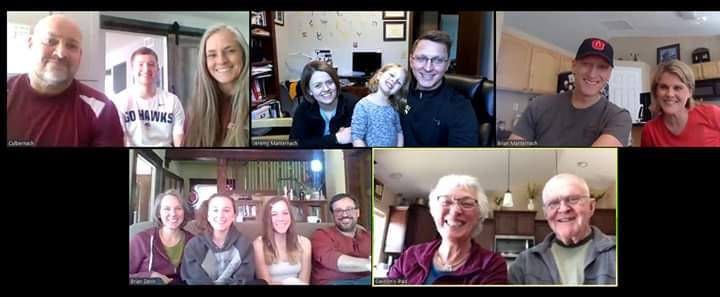
Instead, I create an audience in my head that is comprised of people who are eager to hear me. This audience often includes my family (the family I was born into and the family I have chosen), close friends, and students (some current, some former) whom I know to be enthusiastic learners. These people know me and believe in what I have to offer. They will be rooting for my success but they also will not mind if either my message or my delivery is less than perfect. This is who I perform for, even when none of those people is actually in the room. 

As you are preparing your final performances of this semester, I encourage you to think of who might be in your ideal audience. Imagine those people beaming with pride as you sing, hanging on your every note, and appreciating the depth of all your musical choices. Sing for this crowd as though somebody is listening—a whole room of somebodies who believe you have something valuable to say and who know that your voice is worth hearing. 

And whether or not I ever earn a spot in your ideal audience, I am honored to be one of the people listening to you. 

We're almost there. Let's finish strong. 

Now go practice. 

Some of my ideal audience members.

Sunday, November 8, 2020

What's the benefit of learning classical songs?

As many of you know, the curriculum for anyone taking voice lessons through the Department of Theatre includes study and performance of at least one song in a classical genre (opera, oratorio, art song) each of your first six semesters. For the first couple of years, this tends to involve songs from the good ol' 26 Italian Songs and Arias book. 

Why do we put you through this unique form of torture? Don't we understand that you are theater majors and not opera majors? These are fair questions. There are actually a number of practical reasons it can benefit theater majors to develop a vocal technique appropriate for singing in multiple genres, especially classical. 

First, there are musicals (and specific roles within musicals) that require a vocal sound that is much closer to classical than to contemporary mix/belt. This includes many musicals of the Golden Age as well as some modern shows, like A Light in the Piazza and A Gentleman's Guide to Love and Murder

Second, an increasing number of professional opera companies are adding musicals to their seasons, and they generally perform those musicals with more of a classical sound. Case in point, several years ago, both the Pioneer Theatre Company and Utah Opera produced Man of La Mancha within a couple seasons of each other. Pioneer's production employed a more contemporary music theater sound, whereas Utah Opera's production was decidedly more operatic. Even so, both companies hired several of our department students and graduates for the productions because they had the vocal flexibility to adjust their sound accordingly. 

Third, many opera companies (summer-stock companies especially) hire resident artists or resident ensembles for an entire season at a time. Often, these seasons include shows like La Traviata alongside Pirates of Penzance alongside Hello, Dolly! Singers who understand the difference between classical and contemporary musical theatre technique (and who are comfortable singing in languages other than English) could be hired for an entire season of shows. 

Fourth, singers earning performance degrees are eligible for more jobs if they are able to perform with stylistic authenticity in multiple genres. That may involve singing in churches, temples, or synagogues, singing in professional choirs (like symphony choruses), or even being a singing server in a restaurant. One of my students was a waiter in an Italian restaurant and would often get asked to sing. Pulling off an a cappella version of Caro mio ben always earned him better tips!

Of course, in most of these situations, it's not enough to sing with a classical technique. You also have to have a body of classical repertoire that you can draw upon for auditions. Ideally, this would include at least two (if not five) contrasting operatic arias. It would be even better if these pieces are in multiple languages. 

Naturally, none of this is required of you. If you are only interested in performing music theater, that's fine. Even if you're only interested in performing contemporary music theater, that's fine, too. But it does limit your opportunities to get hired. I'm also pretty certain that performing in classical settings will build your musical and performance skills in ways that will make you a stronger music theater performer. It will also build your contacts in the performance world, and that may lead to additional opportunities down the road. 

How has your singing been this week? Now that we're in the last month of the semester, how will you adjust your practicing to make sure you are ready for your final performances? 

Now go practice.


Sunday, October 25, 2020

Imagine yourself at 35

When I was in my early 20s, I had a mentor who, whenever I would go through my litany of worries, would respond, "How are you going to feel about those problems when you're 35?" At the time, being 35 years old seemed like forever away, so it was a little difficult for me to imagine. I don't think I even knew anyone at that time who was 35, so I didn't have a good means of comparison. 

Essentially, this mentor was asking me to look beyond the immediacy of the moment. By viewing life through a wider lens, he wanted me to consider whether my concerns were of the "temporary" or "life-altering" variety. If they were temporary, then my 35-year-old self may not even remember what those worries were. And if my concerns were more serious, even at the life-altering level, he wanted me to think about how my 35-year-old self would feel about how my 20-something self handled the situation. 

Of course, the exercise wasn't intended to diminish how real my problems were at the time. Challenges and difficulties arise in every stage of life. What I was dealing with then wasn't any less serious just because I happened to be younger than I am now. But considering my problems with the wisdom of distance (even imagined distance) did provide some perspective that often helped guide my way forward.

2020 has presented challenges that none of us has ever experienced, and there is no telling what the coming weeks and months will bring. Related to our work together, this semester of mostly online instruction has been, in some ways, better than expected and, in other ways, more difficult than I had anticipated. 

Remembering my mentor's words, it does help me to remember that, eventually, we will all look back at this time (even though I passed 35 a decade ago). Ten, fifteen, or even twenty years down the road, how do you think you will feel about the way you responded to the challenges of 2020? Will you regret missed opportunities? Will you be proud of how you faced adversity? Or will you just be glad to have survived? 

This is a tough year. But imagine yourself at 35. How will you hope 2020 will have impacted you? How are you staying motivated to continue progressing and working toward a better future? 

Now go practice. 


Sunday, October 11, 2020

Drivers Ed, Part Two ("Motor" Learning)

In the last blog, I compared the processes of learning to sing and learning to drive. At the risk of extending a metaphor too far, there is another relatable takeaway from this analogy. Although I didn't realize it at the time I was in driver's ed, I appreciate now how skillfully my instructor guided me through the stages of motor learning. [Note: "Motor" learning in this case refers to the movement of muscles during skill acquisition. It has nothing to do with the engine of a vehicle...or does it?]

I have written about the stages of motor learning quite a bit in previous blogs (here, here, here, and also here), as they are outlined in The Vocal Athlete by Wendy D. Leborgne and Marci Rosenberg and Vocology by Ingo Titze and Kittie Verdolini Abbott. As a reminder, the first stage of motor learning (the verbal/cognitive stage) is where you're just starting to explore a new skill and getting a feel for what you're doing. This stage requires a lot of repetition, a lot of failed attempts, and a lot of directions from a teacher (augmented feedback). 

When I was in the verbal/cognitive stage as a driver, my teacher was giving me nearly constant directions. He would tell me when to let up on the gas pedal and when to begin applying the brake for upcoming stop signs. He would tell me how far before an intersection I should activate my turn signal and would remind me often to check the mirrors to see what was behind me. It seems ridiculous now to think that anyone ever had to tell me something like, "Put the car into park before you open the door to leave the vehicle." But, at that early stage in the process, I needed specific directions and frequent reminders. 

Given the potential seriousness of "failed attempts" when operating a motor vehicle, my instructor chose the relatively safe environs of an empty parking lot and the sparsely-populated streets of my hometown for my first driving experiences. Only when my skills progressed in those situations was I given the additional challenges and higher speeds of highway driving.

Eventually my skills reached the second stage (the motor learning stage) and I started to get the hang of what I was doing. I was beginning to refine the basic skills of driving and I could perform most tasks without such explicit instructions from my teacher. Instead, his augmented feedback shifted from directions to questions. As I was driving, he would ask me, "How fast are you going right now?" "Is there anyone behind you?" "Is anyone in your blind spot?" "How many miles is it until the next town?" "What's the reading on your temperature gauge?" This allowed me to assess what I was doing, evaluate whether an action was needed, and choose how to respond. In short, his questions were designed to help me develop my self-diagnosis skills. 

Sometimes he would articulate observations that would speculate about the future. I remember once he said, "I see that the car in front of us has an out-of-state license plate. I wonder if that driver has been on this road before. He may not know that the speed limit is about to lower because of the sharp turn ahead." In this way, he was teaching me to anticipate potential problems or hazards before they even came up. 

Similarly, my teacher would sometimes simply call my attention to different options. He would say, "You're going to need to turn left eventually so you can probably start looking for a safe opportunity to change lanes." He no longer had to tell me how to change lanes or exactly when to do it. But he continued to help me consider challenges that were farther "down the road." 

One of the characteristics of the third stage of motor learning (the automatic stage) is that you can execute the skills in different settings, different situations, and among distractions. Sometimes simply a change of setting was enough to provide unique distractions. City driving, for instance, usually meant trying to maintain focus among blinking advertisement signs, streets lined with stores and restaurants, and an increase in traffic. Sometimes, on the relatively distraction-free open highway, my instructor would create distracting tasks for me, like turning on the radio and tuning to a particular station while driving. Then he would ask me to change to a different station or to adjust the volume. Trying to do too many things while driving (like texting) is known to be dangerous, but a certain degree of multi-tasking is inevitable and has to be practiced. 

Once again, we can see how these stages of motor learning relate to singing and how the role of the teacher shifts from providing answers and direction to asking questions that allow students' self-diagnosis skills to develop. 

As singers approach the automatic stage, the ultimate distraction is singing in front of an audience. Singers can ask themselves: Are my skills automatic enough that my singing is more or less the same when I am in front of an audience as when I am alone in a practice room? Even if I may feel nervous when performing, is my singing relatively consistent regardless of whether I am in an audition, in front of my peers, or in front of an audience of strangers? 

Take note of where you are in your progression through the stages of learning this week. Notice which skills you are able to self-correct and which require more outside help. Consider how automatic you may be in certain skills, as well. Then give your singing the green light. 

Now go practice. 

Oh, the places you'll go...


Sunday, September 27, 2020

Drivers Ed

    Learning how to drive was an important rite of passage for me in my early teen years. It was a big deal to be able to get behind the wheel so, once I was old enough, I was eager to start the process toward earning my driver's license. 
    The first thing I had to do was to pass a written test in order to get my driver's permit. This meant studying DMV materials until I could demonstrate a basic knowledge of laws, procedures, and general rules of the road. 
    Once I earned my permit, I was allowed to enroll in a summer-long driver's ed course. Besides a class component (with lectures and exams), this course also required that each student log a certain number of hours of supervised driving. 
    During my first of these supervised trips, my instructor had me drive around an empty parking lot, just to make sure I could stop and start smoothly and safely maneuver the car. He gave me step-by-step directions to make sure I did everything right: "Put your hands on the steering wheel at ten o'clock and two o'clock. Press the brake and put the car into drive. Remove your foot from the brake and slowly press down on the gas pedal." It all seems so rudimentary now, but it was my first time operating a motor vehicle, so it was important not to take on too much too soon. 
    Once I was sufficiently capable of these basics, we headed out into the relatively uncrowded streets of my small hometown. Instead of the wide-open space of the parking lot, now I had curbs and lanes to negotiate, complete with oncoming traffic reminding me of how important it is not to drift outside of my designated lane. 
    When I could handle driving at these slower speeds, my instructor eventually directed me onto the highway to see what it was like to drive at 55 mph. Now he directed my attention to what was further off in the distance, since higher speeds meant obstacles that seemed far off would need to be contended with sooner than expected. Inevitably, we would come up behind a tractor or a combine (this was Iowa, after all) and I would have to check my mirrors, use my turning signal, and safely pass these slow-moving vehicles. 
    My last supervised trip was into the big city (OK, it was Cedar Rapids, which was less than 110,000 people at the time...but it was big to a small-town boy like me!). Driving in a more populated area meant changing lanes in traffic, dealing with stop lights every block, and being aware of a LOT more cars on the road. I was practicing all of the same skills I had been learning throughout my driver's education (acceleration, braking, negotiating turns, adjusting to traffic, etc.) but I found it much more difficult in that situation. I could easily see why this driving challenge was saved until the end of my training. 
    I have often thought that learning how to sing is similar to learning how to drive. For those who aspire to be serious (and even professional) musicians, there is a certain amount of "book knowledge" that is necessary: music theory, anatomy and physiology, musical theatre history, etc. 
    Then, in order to build skills, we have to gradually take on increasingly difficult tasks. As those tasks become easier, we can move on to new challenges that will continue to stretch our abilities. 
    Now that I've had my driver's license for nearly 30 years, it seems funny to think that I ever would have been intimidated by driving in mild city traffic or that I would have had trouble passing a tractor on the highway. Similarly, I've been singing so long that it can be hard to remember when I gained certain aspects of my technique and what it was like not to be able to make certain sounds. 
    But I know that I learned both skills the same way: gradually, over time, with lots of instruction, lots of mistakes, and lots of refining amid lots of repetition. I'm confident the same process will help drive your success, as well. 
    How has your singing been this week?
    Now go practice. 

Knowing where you've been can help you plan where you're going.


Sunday, September 13, 2020

Prerequisites for advanced singing

As college students, you're all familiar with prerequisites. Obviously, you can't take Algebra II unless you have passed Algebra I, and you wouldn't want to take Advanced Composition if you have haven't completed Beginning Composition. 

Pre-reqs are a little different in voice studies, however. Since I believe wholeheartedly in the process of "discovering your voice," I want everyone to have the experience of taking voice lessons—even those without professional singing aspirations. To that end, some students have come to my studio as complete beginners and others have come with a significant amount of previous singing training. 

That being said, I believe there are some prerequisites that are necessary for embarking upon advanced vocal studies. 

First, advanced singers should have at least a basic knowledge of vocal anatomy (parts of the body) and physiology (how those parts work) in order to accurately understand what their bodies are doing when they're singing. They don't necessarily need to know every minute detail or have the same in-depth knowledge that you would expect a voice teacher to have, but they should know enough about vocal function in order to self-diagnose certain inefficiencies and prescribe vocal exercises that work with physical reality rather than against it. 

Second, advanced singers should have a good grasp on the main tenets of vocal health. They need to know which vocal uses can cause fatigue and which can lead to undue stress on the vocal mechanism. They should know how to pace their vocal use and how to efficiently train their instruments, and they should understand how lifestyle factors (diet, sleep, hydration, etc.) can impact their vocal health. 

Third, advanced singers should know what professional-level singing sounds like. That doesn't mean they have to imitate other singers, but they should know what the industry standard is (especially if they expect to meet that standard). Ideally, this will be done by thoughtfully observing professional singers in live performance. In lieu of that, thankfully, YouTube is a thing. Recordings of live performances with minimal "aural airbrushing" or studio sound mixing will be the most representative of what's actually going on vocally. Of course, it's perfectly fine to listen to music just for the fun of it. But advanced singers should also take the time to listen with "singer's ears" to try to determine how professional singers create their sound. 

Fourth, advanced singers need to know what their own successful singing feels like and sounds like. This may seem obvious, but in order to consistently create advanced-level sounds, singers need to have enough experience making those sounds to know what it is they are recreating. In other words, their singing should be beyond the trial-and-error guessing game that takes place in the early stages of learning. Naturally, it may vary a bit from person to person as to what designates "successful singing." But in order to reach an advanced skill level, singers must have a foundation to build upon. In fact, it stands to reason that the more singers experience successful singing, the more they will be considered advanced. 

I suspect that if you ask other voice teachers what they would consider prerequisites for advanced singing, you may get a variety of additions to this non-exhaustive list. And, as the Dunning-Kruger Effect indicates, the more we know about a subject, the more likely we are to realize how much more we still have to learn. To that end, the more singers become advanced, the more conscious they may be of all they are not yet able to do and, ironically, the less advanced they may feel

Even so, the more singers can confidently check the boxes indicating that they have met each of these prerequisites, the more likely they are to have graduated beyond the beginning levels of vocal study. 

How has your practice been this week? How are you progressing toward the goals you outlined in the last blog? 

Now go practice. 

"Curiosity is a fuel that powers the engine of human advancement." ―Keigo Higashino